PCI Conducts Midterm Research

The PCI's 2026 Midterm Survey ranks 32 candidates for Senate and Governor by strongest and weakest image using Warner and Banwart's candidates image measure. Scores are the average of ratings on: trustworthy, smart, a good leader, likable, competent, genuinely wants whats best for America, understands the problems faced by people like me. Scores are on a 1-5 agreement. Solid dots are weighted by the actual vote results in each state. 
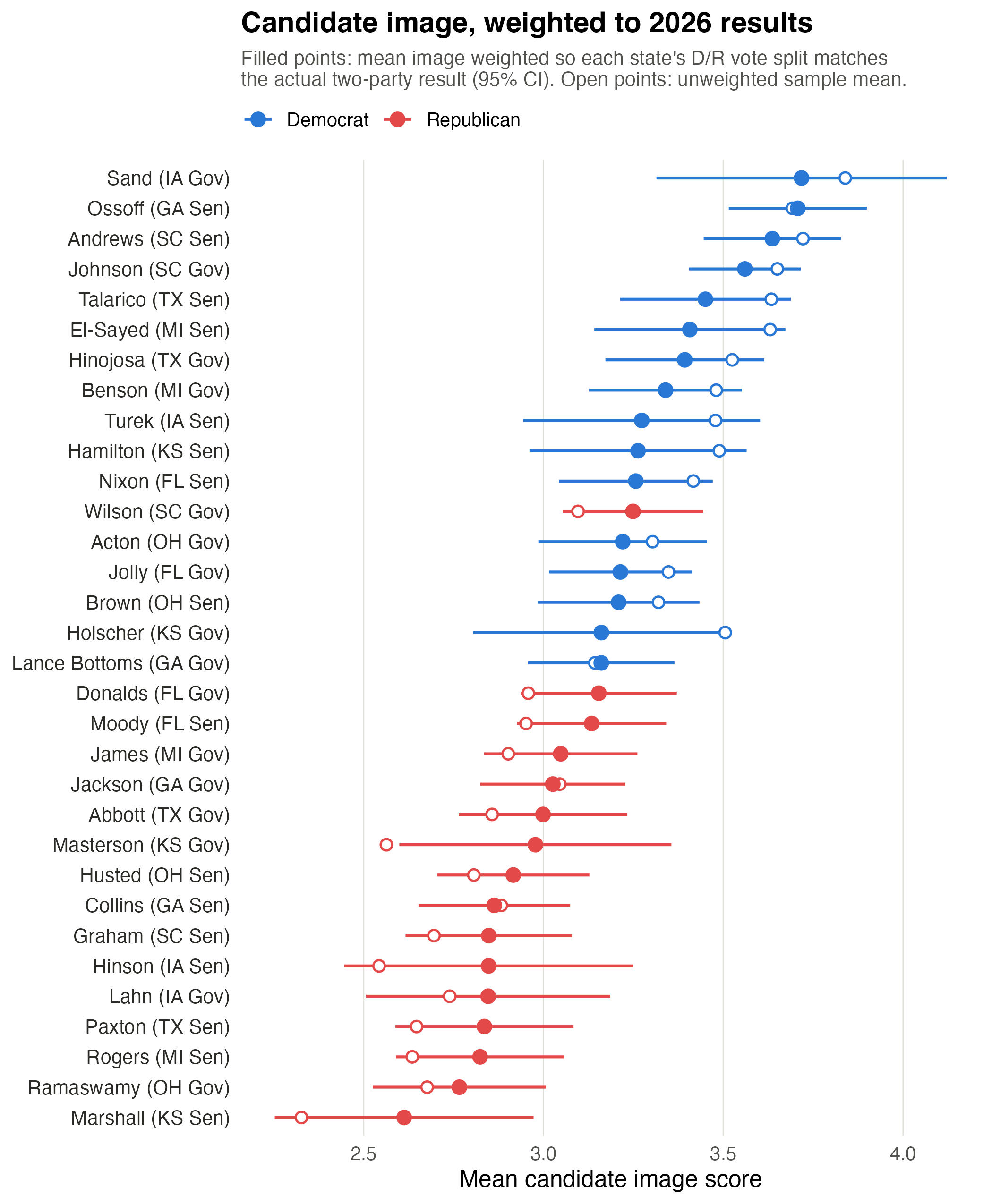
A horizontal dot plot titled “Candidate image, weighted to 2026 results.” Thirty-two candidates from Senate and governor races in eight states (Florida, Georgia, Iowa, Kansas, Michigan, Ohio, South Carolina, Texas) are listed from highest to lowest mean candidate image score. The horizontal axis runs from about 2.3 to 4.1. Filled points show the mean weighted so each state’s Democratic and Republican vote split matches the actual two-party result, with lines for 95% confidence intervals. Open points show the unweighted sample mean. Democrats are blue and Republicans are red.  Democrats fill the top eleven positions, led by Sand (Iowa governor) at about 3.7, followed by Ossoff (Georgia Senate) at about 3.7 and Andrews (South Carolina Senate) at about 3.6. The highest-rated Republican is Wilson (South Carolina governor) at about 3.25, who ranks above five Democrats: Acton, Jolly, Brown, Holscher, and Lance Bottoms, all near 3.2. The remaining fifteen Republicans fall below every Democrat, ranging from Donalds (Florida governor) at about 3.15 down to Marshall (Kansas Senate) at about 2.6.  In most races, weighting moves Democrats’ scores lower and Republicans’ scores higher than the unweighted means, with the largest shifts in Kansas and Iowa. The four Georgia candidates barely change. Confidence intervals are wide, commonly spanning 0.4 to 0.8 points, and many adjacent candidates’ intervals overlap.

Results from a survey of 815 residents of Florida (N=122), Georgia (N=123), Iowa (N=40), Kansas (N=52), Michigan (N=121), Ohio (N=121), South Carolina (N=114), and Texas (N=117) on their attitudes in advance of the 2026 midterms (fielded October 30-November 3).